Southern California pool tile operates in one of the most demanding environments any building material faces: continuous submersion in chemically treated water, intense UV radiation averaging 300+ sunny days per year, thermal cycling between cool winter nights (45°F) and 110°F summer heat in the Inland Empire, and the salinity of pools converted to saltwater chlorination. Pool tile in Southern California that fails (spalling, delaminating, staining, or cracking) requires expensive drain-and-redo repairs in the $8,000–$40,000 range. Getting material selection right from the start is the difference between a pool that looks stunning for 20+ years and one that shows serious deterioration in five.
This guide covers every material option for Southern California pools (waterline tile, pool interior surfaces, coping, and deck) with honest assessments of performance in SoCal's demanding conditions, installation requirements, and cost implications for LA, San Diego, Orange County, Inland Empire, and desert resort markets.
The SoCal Pool Environment: Understanding the Stressors
UV Radiation and Thermal Cycling
Southern California's UV index regularly reaches 10–11 (extreme) in summer, and pool surfaces receive full-day sun exposure in most installations. UV degradation affects organic pigments in colored tile, sealers applied to natural stone, and epoxy grouts. Materials must be specified as UV-stable: through-body porcelain and glass tile (with inorganic pigments) are inherently UV-stable; natural stone with topcoat sealers requires more frequent reapplication.
The thermal cycling challenge is severe in inland SoCal: a pool deck in Riverside or Palm Springs moves from 45°F winter nights to 100°F+ summer deck surface temperatures. This 55°F+ daily variation in shoulder-season months causes significant freeze-thaw-equivalent stress on tile installation systems even without actual freezing, the thermal expansion and contraction of concrete pool shells requires tile and installation systems capable of accommodating this movement.
Pool Water Chemistry
Proper pool water chemistry is maintained at pH 7.2–7.8, but pools regularly drift outside this range. Tile in SoCal pools must tolerate:
- Chlorine and hypochlorous acid (traditional chlorine pools)
- Salt water (3,000–4,000 ppm sodium chloride in saltwater pools, increasingly common in SoCal, now estimated at 40–50% of new pool builds)
- Calcium hypochlorite (shock treatment) at elevated pH when added directly
- Scale formation from SoCal's hard water (typical Saturation Index runs high)
All pool tile must be rated for pool water chemical exposure. Natural stone tile in pool applications, especially below the waterline, requires careful acid-resistance evaluation and penetrating sealer specification.
Hard Water and Calcium Scale
Southern California water (delivered by Metropolitan Water District, local municipal systems, or well water in desert areas) is some of the hardest in the country, with calcium hardness levels of 300–500+ ppm in some areas. This hard water creates calcium carbonate scale deposits on all pool surfaces, but particularly on tile at the waterline. Scale buildup is primarily a maintenance issue (removed by acid washing or specialized scale removers) rather than a tile failure issue, but some tile materials and finishes are more scale-prone and harder to clean than others.
Key fact: The Pool & Hot Tub Alliance (PHTA) and ANSI/APSP standards specify that pool tile must achieve water absorption of ≤0.5% (the porcelain standard) for submerged applications. In SoCal's hard-water environment, tile with higher water absorption allows calcium-rich water to penetrate the tile body, where it deposits calcium carbonate internally, causing a process similar to subflorescence in natural stone that progressively destroys the tile from within. This is why glass tile and through-body porcelain dominate professional specifications for SoCal pool waterline applications while natural stone carries significant risk below the waterline.
Waterline Tile: The Primary Visual Feature
The waterline tile band, typically 6" of tile height running around the pool perimeter at the water surface, is the most visible and most demanding position in pool tile specification. It's constantly wet and dry cycling, exposed to the highest concentration of chemical residue, and at direct eye level from the pool deck and interior.
Glass Tile: The SoCal Standard
Glass mosaic tile dominates SoCal luxury pool waterline applications, and for good reason. Glass pool tile offers:
- Zero water absorption: Glass has 0% absorption: no porosity means no calcium infiltration, no freeze-thaw damage, and no chemical absorption
- UV stability: Inorganic glass pigments are completely UV-stable; colors maintain their intensity indefinitely
- Chemical resistance: Glass is essentially inert to pool chemistry at normal pH and chlorine ranges
- Optical quality: Light refraction through glass creates the luminous, shimmering quality at the waterline that defines the luxury pool aesthetic
- Saltwater compatibility: Unlike some metal trim products, glass is fully salt-resistant
Glass tile costs more than ceramic or porcelain: $15–$45/sq ft for 1"x1" or 2"x2" glass mosaic from quality producers (Bisazza, Oceanside Glasstile, Fireclay). Premium Italian and American glass mosaics at $45–$120/sq ft are used in the highest-end SoCal pool projects. Installation cost for glass mosaic is higher than porcelain, $18–$30/sq ft labor, due to the precision required for face-mounted mosaic installation and the risk of cracking glass tile during cutting.
Through-Body Porcelain: Value-Performance Leader
For pool owners who want durability without the glass tile price premium, through-body porcelain at ≤0.5% water absorption is the professional-grade specification. Pool-rated through-body porcelain in 2"x4" or 4"x4" mosaic formats is common in the SoCal mid-market pool renovation and new construction sector. Cost: $6–$18/sq ft for material; $10–$18/sq ft for installation.
Key specification: verify the tile is rated specifically for pool and wet area application. Some through-body porcelains are fine for pool use; others have surface treatments that degrade in continuous submersion. Ask for explicit pool application rating from the manufacturer or distributor.
Natural Stone Tile at the Waterline: Use with Extreme Caution
Travertine, limestone, and even dense marble at the waterline in SoCal pools are problematic. The constant wet-dry cycling extracts and redeposits minerals; calcium scale bonds tenaciously to stone surfaces that are harder to acid-clean than glass or porcelain; and stone's higher porosity allows chemical-laden water to penetrate and alter the stone from within. Natural stone at the waterline in SoCal's hard water and high-UV environment requires professional cleaning every 6–12 months and resealing every 1–2 years, maintenance intensity most pool owners don't commit to, resulting in rapid deterioration.
Pool Interior Finishes: Plaster vs Pebble vs Tile
Full-Tile Interior
All-tile pool interiors are the ultimate specification, used in ultra-luxury SoCal pools where the full glass mosaic or premium porcelain interior is both the aesthetic goal and the most durable long-term choice. A full-tile interior eliminates the replastering cycle (standard plaster lasts 7–12 years; pebble finishes 15–20 years; tile lasts 30–50+ years with proper installation). Full-tile interiors for a 400–600 sq ft pool cost $40,000–$120,000+ depending on tile selection and installation complexity.
Pebble and Quartz Interior with Tile Waterline
The most common SoCal pool specification: pebble aggregate or quartz finish for the pool interior with a dedicated waterline tile band in glass or porcelain. This combination balances cost (pebble/quartz interior at $8,000–$18,000 for a standard pool) with the durability benefits of glass or porcelain tile exactly where the hardest conditions occur. Pebble finishes (Pebble Tec, Pebble Sheen, Diamond Brite) perform well in SoCal conditions with proper water chemistry maintenance.
Pool Coping and Deck Tile in SoCal
Coping
Pool coping, the cap material at the pool edge, must handle both pool water exposure and full sun deck-side conditions. SoCal coping specifications:
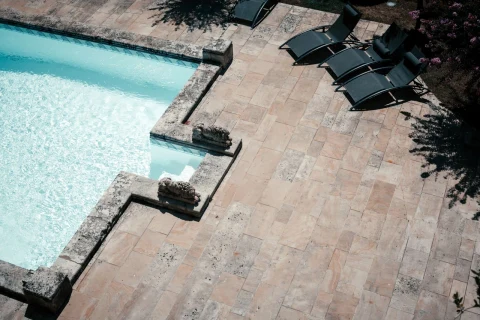
- Porcelain pavers (20mm thickness): Through-body porcelain coping pavers at 24"x24" or 24"x12" are the current market preference: UV-stable, low maintenance, DCOF-compliant for wet barefoot use; $8–$18/sq ft material
- Natural travertine: Traditional SoCal pool coping; warm aesthetic; requires annual sealing; pools in the 1–3 mile coastal zone require more frequent maintenance; $12–$25/sq ft material
- Bullnose porcelain tile: For pools with raised bond beams, 12"x24" or 24"x24" bullnose porcelain provides a clean contemporary edge; most cost-effective coping option
Deck Tile and Pavers
The pool deck surrounding the pool must meet strict safety standards in SoCal's barefoot-exposure environment:
- DCOF ≥0.60 minimum for pool deck surfaces per ANSI A137.1: wet barefoot surfaces need higher DCOF than standard indoor tile
- UV-stable and heat-reflective: Dark tile on a SoCal pool deck absorbs heat to painful surface temperatures in summer; light-colored or textured tile is both cooler and safer
- 20mm porcelain pavers over pedestals: An increasingly popular specification for SoCal pools: 24"x24" or 24"x48" 20mm porcelain pavers set over adjustable pedestals allow drainage below the deck, eliminate installation mortar that can crack in thermal cycling, and create a premium floating-deck aesthetic
Pro tip: SoCal pool owners converting to saltwater chlorination should notify their tile contractor before any tile work. Saltwater pools (3,000–4,000 ppm) accelerate corrosion of metal tile accessories and can degrade certain epoxy grout formulations over time. For saltwater SoCal pools, specify 316 marine-grade stainless steel or polymer trim profiles, epoxy grout products specifically tested for saltwater pool environments (ask manufacturers for explicit saltwater compatibility data), and glass or through-body porcelain tile only, no natural stone below the waterline.
Installation Requirements for SoCal Pool Tile
Proper installation is as important as material selection for SoCal pool tile longevity:
- Thin-set specification: Two-component epoxy thin-set or polymer-modified medium-bed mortar with ≥95% coverage: no voids behind waterline or submerged tile; voids allow water pressure to build and delaminate tile
- Grout specification: Epoxy grout only for submerged applications; polymer-modified cement grout for above-waterline coping with sealed joints; no standard cement grout in pool water contact zones
- Movement joints: Expansion joints at corners and in deck field tile every 8–10 feet; SoCal's thermal cycling causes significant movement in pool shell concrete, and without proper movement accommodation, even the best tile will crack
- CPCB license: California Contractors State License Board Class C-53 (Swimming Pool) license required for all pool tile work in California; verify contractor licensing at contractors.cslb.ca.gov
Summary: Invest in Material Quality for SoCal Pool Tile
Southern California pool tile faces extraordinary combined stressors (UV, thermal cycling, hard water scale, and pool chemistry) that separate durable specifications from failures within just a few years. Glass mosaic tile at the waterline, through-body porcelain for decking and coping, epoxy grout throughout submerged zones, and 20mm pedestal pavers for pool decks represent the current professional specification for SoCal pools built to last 20–30 years without major replacement. The additional upfront cost of premium materials is justified in every case by the cost of pool draining, tile removal, and reinstallation when inferior materials fail prematurely.